
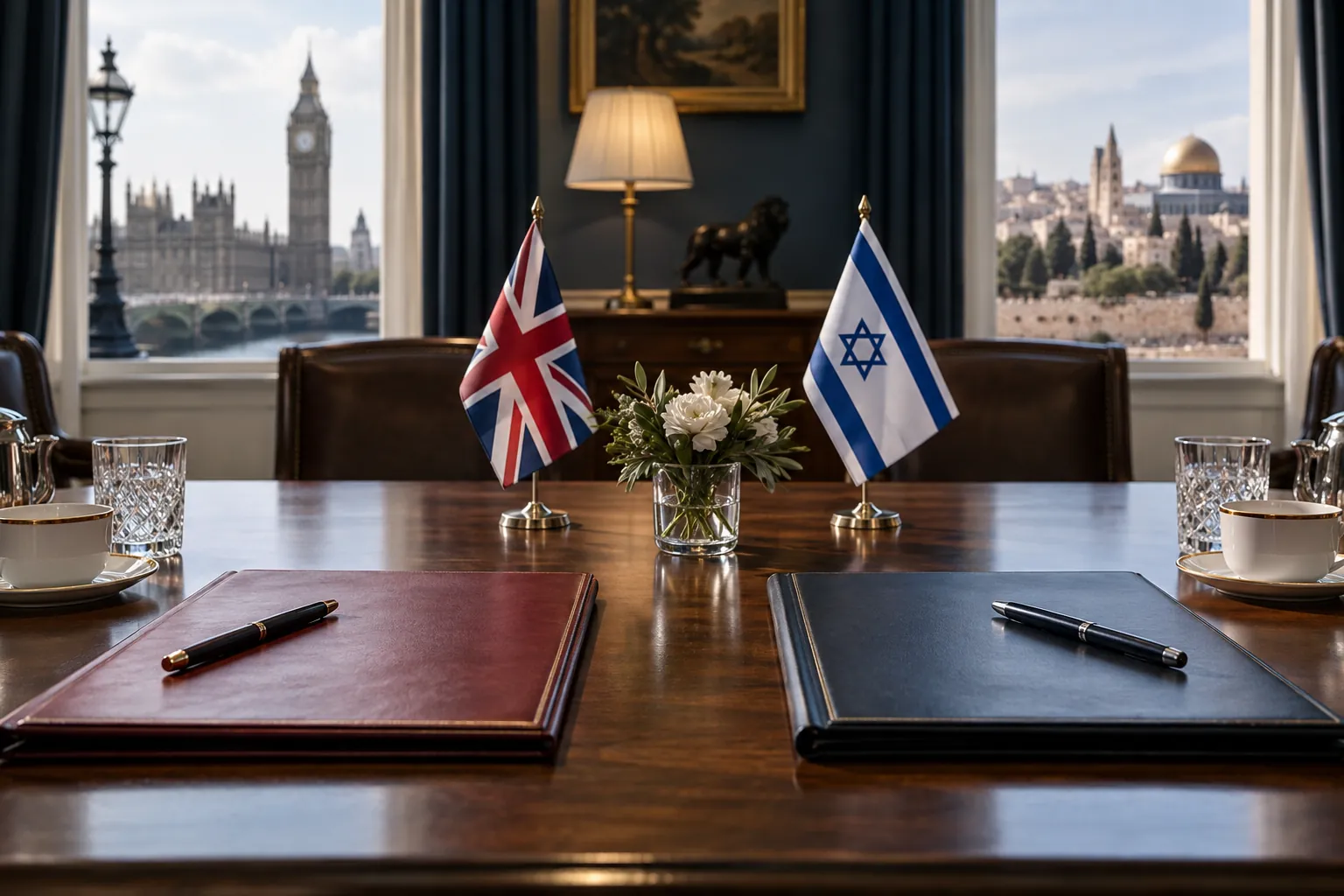
Britain is attempting to pursue two policies towards Israel at the same time.
In his address to the United Nations General Assembly on 22 September, Prime Minister Andy Burnham condemned the Hamas attacks of 7 October, spoke of the threats posed by Iran and affirmed Britain’s commitment to the security of Israel and Jewish people. At the same time, he defended a significantly tougher British approach towards Gaza, the West Bank and Israeli settlements.
This emerging doctrine combines continued strategic cooperation with growing political and economic pressure. The Government insists that the two elements are compatible. Whether that distinction can be maintained is now one of the central questions facing UK-Israel relations.
What has Britain announced?
The Government has announced restrictions on trade in goods produced in Israeli settlements and on certain services connected with settlement expansion. It has also expanded the sanctions framework available for targeting individuals and organisations associated with settlement activity.
These measures are directed at settlements rather than Israel as a whole. Official British guidance continues to describe wider commercial ties with Israel as important and valued, and UK-Israel cooperation in technology, intelligence, defence and counter-terrorism remains substantial.
Not every announced measure is fully operational. Some restrictions require legislation and detailed guidance before businesses can know precisely what is prohibited. That makes it important to distinguish policy announcements from the eventual legal framework.
Pressure beyond government
The policy is already influencing the wider debate. The co-chairs of the Britain-Palestine All-Party Parliamentary Group have written to banks and financial institutions asking them to examine potential exposure to the E1 settlement project.
That letter is an enquiry about governance, due diligence and risk. It is not proof that the institutions contacted are financing E1, nor is it itself a new banking regulation. Nevertheless, it illustrates how government policy can encourage pressure on private institutions before the final legal rules are settled.
Israel’s response
Israel has rejected the British measures and announced countermeasures, including the closure of the British Consulate in Jerusalem. Israeli officials argue that Britain is moving from legitimate diplomatic disagreement towards an architecture of sanctions and exclusion.
That concern should not be dismissed. A policy presented today as narrowly targeted can establish mechanisms that campaigners later seek to extend. British ministers therefore have a responsibility to explain clearly where the boundaries lie and how they will protect the wider strategic relationship.
A relationship that requires honest engagement
Friends and democratic allies can disagree. Britain is entitled to criticise Israeli policy, just as Israel is entitled to challenge British decisions. But durable influence comes from direct engagement, clarity and an understanding of regional security—not from allowing a strategic partnership to be reduced to a sequence of sanctions.
Britain says it wishes to preserve cooperation with Israel while applying pressure over settlements. The coming months will show whether that balance is sustainable or whether the new restrictions become the starting point for something broader.
Sources: Prime Minister’s UN General Assembly speech; House of Commons Library briefing; Israeli response.